
REVIEW · WORKSHOPS
Hands-on Embroidery Workshop
Stitches turn plain cloth into art. This 2-hour Embroidery Fundamentals & Embellishment Techniques Workshop in Jaipur is a hands-on skill session that walks you through stitch basics and decorative effects, with steady help from Mohit and the team at Creatis. I also really liked the finished result, plus the take-home extras like an embroidery hoop, so you can keep going after the class.
One practical thing to plan for is getting there on your own. There is no hotel pickup, and the workshop starts in Jaipur’s Industrial Area behind Tata Motors Service Center, so give yourself a little time to find it.
Key highlights before you book
- Small group size (up to 15) means you are not stuck waiting your turn.
- Two project styles let you choose a hooped sampler for display or a sew-on patch for clothes and accessories.
- Stitch families with real structure cover borders, outlines, fills, texture, accents, and joining.
- 3D effects show you how to create raised, sculptural embroidery on fabric.
- Embellishment techniques focus on beads, mirrors, sequins, and coils, plus how to attach them securely.
- A relaxed studio vibe includes guidance that is as detailed as you need, in a clean, comfortable space with music.
Other things you can learn to make here
- Pink City Cooking Class★ 5.0 · 452 reviews
- Jaipur Market Tour & Vegetarian Rajasthani Home Cooking Class★ 5.0 · 113 reviews
- Cooking Class in Jaipur – Family Experience with Meal & Transport★ 5.0 · 101 reviews
- Interactive Cooking Class with a Local Family in Jaipur★ 5.0 · 90 reviews
Embroidery Fundamentals at Creatis, Jaipur: A 2-hour craft session that actually builds skills
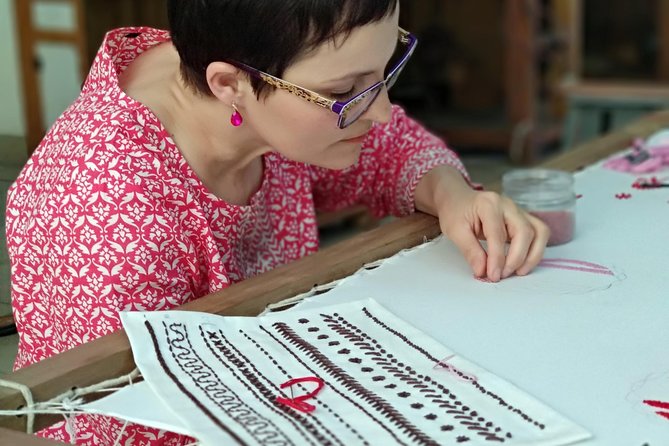
If you want a creative Jaipur activity that feels practical, not just performative, this hands-on embroidery workshop hits the mark. It is designed for beginners, but it does not talk down to you. You learn by doing, with enough structure to understand what each stitch family is for, and enough freedom to make it your own.
The class runs about 2 hours, so it is short enough to fit into a busy itinerary, yet long enough for you to see how embroidery changes a piece of plain fabric. You start with basics like preparing fabric and transferring designs, then move into stitches that create clean outlines, fill texture, and add tiny details. After that, you experiment with decorative and raised work, including embellishments like beads and mirror-style shine.
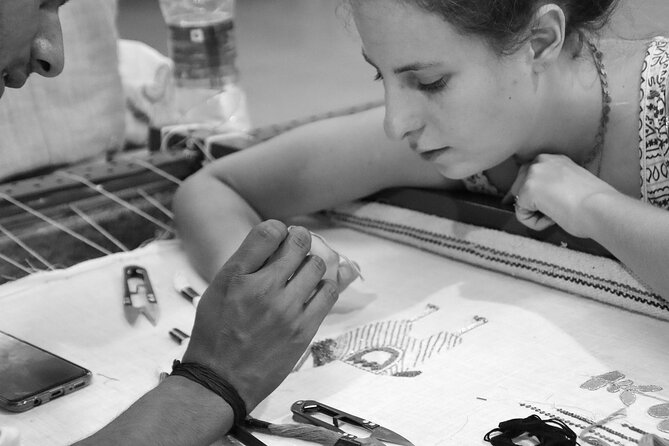
The “feel” matters here. The studio setup is described as clean and open, and the teaching rhythm is calm. In particular, Mohit (the manager) keeps things comfortable and guided, so if you get stuck, you are not left guessing.
Where the workshop starts: the Creatis meeting point you should find before you’re hungry
This class begins at Creatis at A12 Sudarshanpura RIICO, behind Tata Motors Service Center, Industrial Area, Sudarshanpura, Bais Godam, Jaipur, Rajasthan 302006, India. It ends back at the same meeting point.
A key practical note: there is no hotel pickup. If you are relying on local transport, this is still workable, because it is near public transportation, but you should plan to reach the address under your own steam. I suggest building in extra time the first time you do this kind of industrial-area navigation, especially if you are unfamiliar with Jaipur neighborhoods.
Dress code is smart casual. Keep it comfortable for sitting and working at a table for about two hours. If you wear something you love, that is fine, but expect the normal craft risk of a stray thread or a little sparkle dust if you are working with sequins or mirror-like pieces.
What you learn first: tools, materials, fabric prep, and design transfer
Good embroidery instruction starts with setup. This workshop begins with familiarizing you with the basic tools and materials used in traditional embroidery. You also learn how to prepare your fabric and transfer designs so your work has a clear starting point.
For beginners, this part is more important than it sounds. The biggest frustration in embroidery is not the stitches. It is starting crooked, transferring the design poorly, or using fabric that is difficult to work with. By teaching the basics up front, the class helps you get to the fun part faster, and your later stitching looks cleaner.
You also get a clear sense of what the instructor expects from your project, so you can focus on learning rather than reinventing the process.
Stitch families that make fabric look alive: borders, outlines, fills, texture, and details
Once your materials are ready, you move into stitches grouped by purpose. The workshop focuses on the idea that a limited set of stitches can do a lot of visual work when you use them correctly.
Here is how the stitch learning is framed:
- Borders and outlines: You learn how to frame your work with clean edges and defined shapes.
- Fill and texture: You explore patterns and coverage that create surface interest, not flat emptiness.
- Details and accents: You add small touches that make the overall piece feel finished.
- Structural and joining: You learn stitches that hold elements together with subtle strength.
- From fine lines to bold textures: You practice the contrast between delicate linework and more substantial surface effects.
This is the “skills that transfer” part. Even if you do not want to become an embroidery expert, you learn how designers think. Clean outlines guide the eye. Texture makes the piece feel tactile. Strategic accents give it that last 10 percent that makes you say, “Okay, that looks right.”

3D and decorative techniques: raised work that lifts off the fabric
If you like embroidery that looks more sculpted than flat, this workshop covers 3D and decorative effects. You experiment with ways to create raised, sculptural forms that lift off the fabric.
This part is often what separates basic embroidery from the more eye-catching regional styles you see in finished clothing, bags, and wall pieces. The instruction is meant to keep the learning practical, not theoretical. You get to test what the “raised” look feels like, and what it takes to make those raised areas look intentional rather than accidental.
A possible consideration here: if you want ultra-advanced, highly technical work, two hours is not that kind of class. But for building a real foundation and leaving with a piece you are proud of, it is a smart length.
Embellishment time: beads, mirrors, sequins, and coils (and how not to lose them)
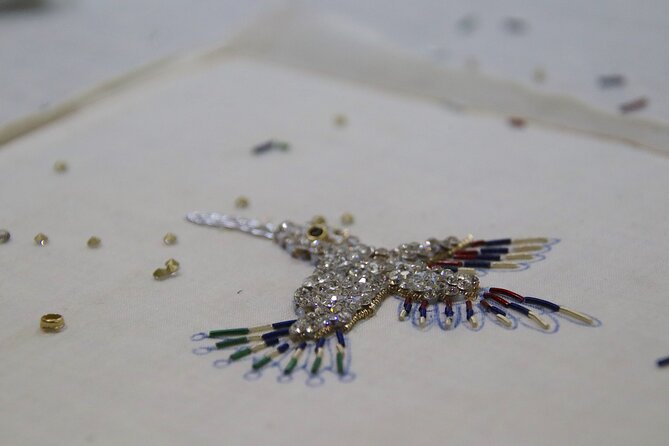
Then you get into embellishments, the part that makes embroidery go from pretty to wow. The workshop teaches embellishment techniques using beads, mirrors, sequins, coils, and more. It also includes practical tips for secure, long-lasting attachment to fabric.
This matters. Embellishments are easy to add but harder to keep. If they are attached loosely, they can fall off after wear or washing. By focusing on secure attachment, the class helps you avoid the classic souvenir-problem: a piece that looks great for a photo, then does not survive daily life.
This is also where the workshop’s “guidance as you need it” shows up. You can experiment, but you still get correction and direction so your decorative work stays neat.
Hooped sampler vs sew-on patch: choose what you want to use, display, or wear
You get to choose your project style, and that choice affects how you think during the class:
- Hooped Sampler: Ideal if you want something you can display. You are building a finished look meant to be seen.
- Sew-On Patch: Ideal if you want to embellish clothing or accessories. Your work becomes a wearable, practical design element.
I like that this is not one-size-fits-all. If you want an embroidery project that becomes part of your daily life, the patch is a straightforward idea. If you want something you can frame or hang, the hoop sampler makes sense.
During the session, you practice the stitches and decorative techniques with your chosen end in mind, so the time does not feel random. It is all connected to what you will take home.
What you take home, and why it boosts the value
This workshop is priced as an activity, not just a lesson. And that shows in the “keep creating” factor. You are given materials, and you also get take-home goodies, including an embroidery hoop in at least one described experience.
That is a big deal for value. A lot of craft classes end with a half-finished item or a kit you never touch again. Here, you are more likely to continue because you have the tools right away and a finished example to build from.
Also, the take-home part changes the way you experience the class. You pay attention to what you are doing because you know it will become a real object, not just a practice page.
Price and value: is $25.50 for embroidery fundamentals actually fair?
At $25.50 per person, for an approximate 2-hour hands-on workshop in Jaipur, the price feels reasonable when you factor in what is included. The listed cost includes all taxes, fees, and handling charges, plus GST.
The bigger value question is what you get for that money. In this case, you get:
- Guided learning of multiple stitch categories
- Decorative practice with beads, mirrors, sequins, and coils
- A choice of a hooped sampler or sew-on patch
- Materials provided during the session
- Take-home items that help you continue
The main thing not included is hotel pickup, so you will need to handle your own transport to the Creatis meeting point. If you already plan to use local transport or rides, that is not a dealbreaker. If you require door-to-door service, it could feel annoying.
For most people, though, the class is a good use of a creative afternoon because you walk out with a tangible result and the basics to keep improving.
Who this workshop suits best (and who should pick something else)
This is a strong fit for:
- Beginners who want structure and quick wins
- People who like craft sessions that are hands-on and relaxing
- Travelers who want a small-group activity that does not require art-school confidence
- Anyone curious about Indian-inspired embroidery details like beads and mirror-like decoration
It is also a good option if you like pairing creative activities. One described day combined embroidery in the morning with block printing later. If your schedule allows, this kind of two-crafts combo can make a full creative day in Jaipur feel coherent.
It may not be ideal if:
- You want long, deep instruction over multiple sessions
- You are not comfortable reaching the studio on your own (since there is no pickup)
- You need a very fast, sit-and-watch experience. This is a do-it-yourself class.
Tips for a smooth visit at Creatis
A few small things make the workshop feel easier:
- Wear smart casual clothing that you can sit in comfortably for a couple of hours.
- Bring your best patience for tiny details. Embroidery is mostly patience, not speed.
- If you choose the patch, think ahead about where you might attach it, like a tote bag, jacket, or shirt pocket.
- If you choose the hoop sampler, plan how you want to display it before you leave, so you do not end up stuffing it in a bag.
Finally, lean into the guidance. The team is set up to help you get what you want out of the session, and a good playlist and relaxed vibe make it easier to stay focused.
Should you book this embroidery workshop in Jaipur?
If you want a hands-on embroidery class that teaches the fundamentals, adds decorative sparkle, and results in a real take-home piece, I think this workshop is a smart booking. The small group size, the focus on stitch categories, and the attention to secure embellishment make it more than a casual craft stop.
I would only hesitate if you strongly prefer hotel pickup or if you are looking for an ultra-advanced embroidery masterclass. For most travelers, though, two hours is exactly the sweet spot: long enough to learn, short enough to fit into Jaipur, and structured enough that your finished sampler or patch looks like a project, not a messy experiment.
FAQ
FAQ
What is the duration of the embroidery workshop?
The workshop runs for about 2 hours.
How much does the workshop cost?
It costs $25.50 per person.
Where does the workshop start?
The start point is Creatis, A12 Sudarshanpura RIICO, behind Tata Motors Service Center, Industrial Area, Sudarshanpura, Bais Godam, Jaipur, Rajasthan 302006, India.
Is hotel pickup included?
No, hotel pickup is not included.
Do I get a mobile ticket?
Yes, the workshop uses a mobile ticket.
What is the dress code?
The dress code is smart casual.
What is the minimum age?
The minimum age is 18 years.
How many people are in the group?
The maximum group size is 15 travelers.
What is included in the price?
The price includes all taxes, fees, and handling charges, including GST (Goods and Services Tax).
Can I cancel for a refund?
Yes. You can cancel for free and receive a full refund if you cancel at least 24 hours before the experience’s start time. Changes within 24 hours of the start time are not accepted.
More to Make in Jaipur
- Pink City Cooking Class
★ 5.0 · 452 reviews - Jaipur Market Tour & Vegetarian Rajasthani Home Cooking Class
★ 5.0 · 113 reviews - Cooking Class in Jaipur – Family Experience with Meal & Transport
★ 5.0 · 101 reviews - Interactive Cooking Class with a Local Family in Jaipur
★ 5.0 · 90 reviews - Jaipur: Block Printing Workshop and Hands-on Experience
★ 5.0 · 78 reviews - Hands-on Block Printing Workshop
★ 5.0 · 76 reviews
More Tour Reviews in Jaipur
- Jaipur: Private Full Day Sightseeing Tour By Car with Guide
★ 4.9 · 1,839 reviews - 3-Hour Morning Bike Tour of Jaipur
★ 5.0 · 1,253 reviews - Jaipur: Private Sightseeing Day Tour with Guide by Car
★ 4.8 · 773 reviews - Jaipur: Full-Day City Tour with Car, Guide & Skip-the-Line
★ 4.8 · 512 reviews - Full-Day Jaipur Private Sightseeing Tour by Car with Guide
★ 5.0 · 472 reviews - Pink City Cooking Class
★ 5.0 · 452 reviews
Fresh on the site: newer Jaipur tours we have written up




Workshops, compared.
 ★ 5.0Pink City Cooking ClassFrom $27452 reviews
 ★ 5.0Jaipur Market Tour & Vegetarian Rajasthani Home Cooking ClassFrom $60113 reviews
 ★ 5.0Cooking Class in Jaipur – Family Experience with Meal & TransportFrom $29101 reviews
 ★ 5.0Interactive Cooking Class with a Local Family in JaipurFrom $2690 reviews
 ★ 5.0Block Printing Workshop and Hands-on ExperienceFrom $3578 reviews
 ★ 5.0Hands-on Block Printing WorkshopFrom $2576 reviews
 ★ 5.0Jaipur Pink City Cooking ClassFrom $2073 reviews
 ★ 4.9Interactive Cooking Class with a Local FamilyFrom $2458 reviews
Browse the lists this tour appears in